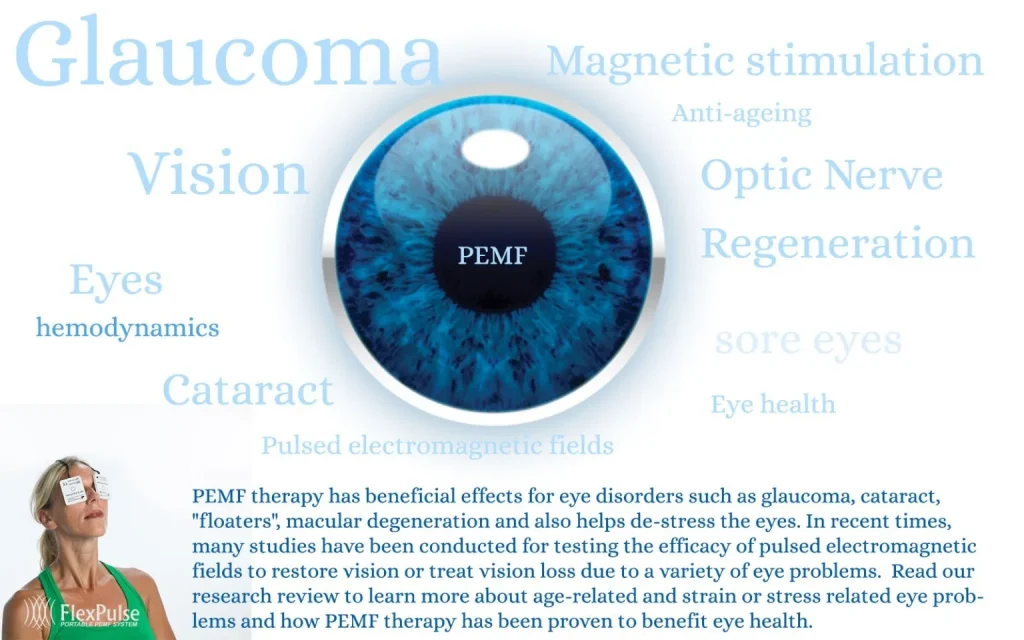
Researchers have studied pulsed electromagnetic field (PEMF) therapy in eye conditions such as glaucoma, cataract and macular degeneration. Most of these studies are small and many are decades old, so here is what they looked at and what they can and can’t tell us.
Eye problems are quite common. In fact, the National Eye Institute’s study on the prevalence of adult vision impairment and age-related eye diseases show that more than 35 million Americans over 40 suffer from one of four major types of eye problems: age-related macular degeneration, cataract, diabetic retinopathy, or glaucoma. Researchers have looked at PEMF in some of these conditions, as summarized below.
Eye conditions such as glaucoma need ongoing care from an eye doctor, and that care can be expensive, as a study from the Glaucoma Research Foundation (GRF) shows. Options include laser surgery and glaucoma medications, which can have side effects.
PEMF is not a substitute for care from your eye doctor. If you have an eye condition, talk with them before trying it.
Research on PEMF, glaucoma and cataracts
Glaucoma
Glaucoma can cause a visual field defect that can cause blindness. Studies of magnetic therapy in older adults have looked at blood pressure1 and circulation2, but those were not eye studies.
A 19903 study of 150 people with glaucoma reported that a course of ten PEMF sessions increased blood flow measures in the eye.
Another small study from 19964, of 31 people with glaucoma, reported improvements in visual field in most eyes after ten 10-minute sessions of magnetic therapy, compared with untreated eyes of the same patients.
A 2010 study5 applied magnetic therapy to nerve centers in the neck in people with early-stage primary open-angle glaucoma and compared it with medication tablets. These studies were small, several are decades old, and all used medical magnetic therapy devices, not a wearable like FlexPulse.
Cataracts
Little research has been conducted specifically on PEMFs and cataracts, so there is no good evidence either way.
One study6 looked at laser magnetotherapy in patients with edema (swelling) reactions after cataract surgery.
Research on PEMF, macular degeneration and other eye conditions
Macular Degeneration
Eye disorders often develop as people age. Macular degeneration is one such condition.
One older study7 used a PEMF system in people with degenerative retina conditions and reported improved visual acuity in some eyes. It was a single study, and results like these would need confirming in larger, controlled trials.
Optic nerve damage
Optic nerve atrophy, or optic nerve damage can result from hereditary genetic disorders, trauma (including stroke), tumor, decrease in oxygen or blood supply, and infections. In 1990, a preliminary study8 looked at low-frequency magnetic therapy in people with optic nerve atrophy.
Several ocular disorders are due to diabetes, including glaucoma and retinopathy.
Magnetic stimulation, vision and reaction time
Research on magnetic stimulation and vision could also interest competitive athletes. Visual afterimages can last for microseconds, interfering with rapidly incoming new images. In the competitive setting, microseconds can affect reaction time and performance, and even be the difference between winning and losing.
A recent experiment9, published in The Journal of Cognitive Neuroscience, found that magnetic stimulation applied to the brain’s visual cortex improved fading of visual afterimages.
How electrical stimulation and PEMF differ
Electrical stimulation has been studied and used as a therapy more often since it is a much older technology.
Electric fields are met with strong tissue resistance, while pulsed magnetic fields pass through tissue and clothing and cover a wider area.
About FlexPulse
The FlexPulse is an affordable, powerful, wearable PEMF system that goes wherever you do. The FlexPulse G2 has a peak intensity of 200 Gauss and 10 preset programs ranging in frequency from 3 Hz to 1000 Hz.
FlexPulse comes with a 30-day satisfaction guarantee and a 2-year warranty on the controller. See Guarantee & Warranty for the full terms.
References
1. Rikk J, Finn K, Liziczai I, Radák Z, Bori Z, Ihász F. Influence of pulsing electromagnetic field therapy on resting blood pressure in aging adults. Electromagn Biol Med. 2013;32(2):165-172. https://www.ncbi.nlm.nih.gov/pubmed/23675619.
2. Abramovich S, Fedotchenko A, Koriakina A, Pogodin K, Smirnov S. [The characteristics of the geroprotective action of magnetotherapy in elderly patients with combined cardiovascular pathology]. Vopr Kurortol Fizioter Lech Fiz Kult. 1999;(5):7-9. https://www.ncbi.nlm.nih.gov/pubmed/10598519.
3. Tsisel’skiĭ I, Kashintseva L, Skrinnik A. [The effect of a pulsed electromagnetic field on the hemodynamics of eyes with glaucoma]. Oftalmol Zh. 1990;(3):154-157. https://www.ncbi.nlm.nih.gov/pubmed/2255478.
4. Bisvas S, Listopadova N. [Possibilities of magnetotherapy in stabilization of visual function in patients with glaucoma]. Vestn Oftalmol. 1996;112(1):6-8. https://www.ncbi.nlm.nih.gov/pubmed/8659077.
5. Veselova E, Kamenskikh T, Raĭgorodkiĭ I, Kolbenev I, Myshkina E. [Magnetotherapy designed to affect cervical sympathetic ganglia for the treatment of patients with primary open-angle glaucoma]. Vopr Kurortol Fizioter Lech Fiz Kult. 2010;(5):21-24. https://www.ncbi.nlm.nih.gov/pubmed/21328900.
6. Maksimov VIu, Zakharova NV, Maksimova IS, et al. Laser magnetotherapy after cataract extraction with implantation of intraocular lens. Vestn Oftalmol. 2002 May-Jun;118(3):15-7.
7. Skrinnik AV and Kovalchuk AS. The impulse electromagnetic field in the treatment of dystrophic lesions of the retina. Oftalmol Zh(8):459-462, 1989.
8. Zobina L, Orlovskaia L, Sokov S, Sabaeva G, Kondé L, Iakovlev A. [Effectiveness of magnetotherapy in optic nerve atrophy. A preliminary study]. Vestn Oftalmol. 1990;106(5):54-57. https://www.ncbi.nlm.nih.gov/pubmed/2264232.
9. Erkelens I, Bobier W, Macmillan A, et al. A differential role for the posterior cerebellum in the adaptive control of convergence eye movements. Brain Stimul. July 2019. https://www.ncbi.nlm.nih.gov/pubmed/31427273.