By Dr. W. Pawluk, MD, MSc
Researchers have studied whether pulsed electromagnetic fields (PEMFs) affect sleep. Sleep issues are common and don’t have one cause. Insomnia, for instance, isn’t a disease. There’s no single definition of sleep disorder that applies to all. Multiple aspects are at play in any given person’s sleep issues, and may include stress and anxiety. Wakefulness itself varies dramatically from person to person. Some have trouble falling asleep (a latency issue). Others struggle to remain asleep. These may be caused by physical urges like wanting to void in the middle of the night, hot flashes, or pain. This article by Dr. Pawluk will help us learn about sleep problems and what research on PEMF therapy and sleep has looked at.
Dangers Of Lack Of Sleep
There are many risks to not sleeping steadily or deeply for 7 or more hours a night. Here is a short list:
- Increased risk of accidents.
- Reduced cognitive functioning.
- Increased risk of serious health problems, involving the heart, high blood pressure, stroke, and diabetes. Close to 90% of people with sleep issues have another health condition.
- Reduces sex drive.
- Fivefold increase in depression.
- Skin aging because of reduced growth hormone levels.
- Increased forgetfulness since long-term memories are not stored properly.
- 30% have increased weight with less than 6 hours a day of sleep.
- Death rates double with less than 5 hours a day of sleep.
- Judgment impairments.
Environmental Electromagnetic Fields (EMFs) And Sleep
EMFs are very common and continuously surround us. Wi-Fi in the house, especially in the bedroom, routers, cell phones in the bedroom, clock radios and smart meters all impact the brain and can disrupt sleep. Reducing exposure to these sources of EMF can significantly improve sleep. Routers should be turned off. Cell phones should be on airplane mode. Clock radios should be moved into farther parts of the bedroom. Removing smart meters would be most ideal. The challenge with removing sources includes removing sources from around you outside your own environment, including neighboring houses or other apartments.
Magnetic fields produced by power lines can significantly impact sleep. Researchers (Graham) used 20 to 30 µT (0.2-0.3 gauss) magnetic fields at 60 Hz with continuous exposure. These PEMFs did not significantly alter sleep patterns. When the stimulation patterns were changed to alternate 1 hour on/1 hour off over the 8 hours of sleep, and when on, switched on and off every 15 seconds, results were very different. This interrupting pattern caused:
- poor and broken sleep (decreased sleep efficiency),
- suppression of REM sleep, and
- sleeping less well at night and feeling less rested in the morning.
This study approach was used to duplicate what would happen in people’s homes from 60 Hz powerline EMFs. When exposure was continuous, sleep was not negatively affected. The implication for PEMF use at night is that continuous exposure is preferable to intermittent or interrupted exposures.
Research About PEMF Therapy And Sleep
Here is a quick summary of some research studies on PEMF therapy and sleep. They are small, several are decades old, and none used FlexPulse.
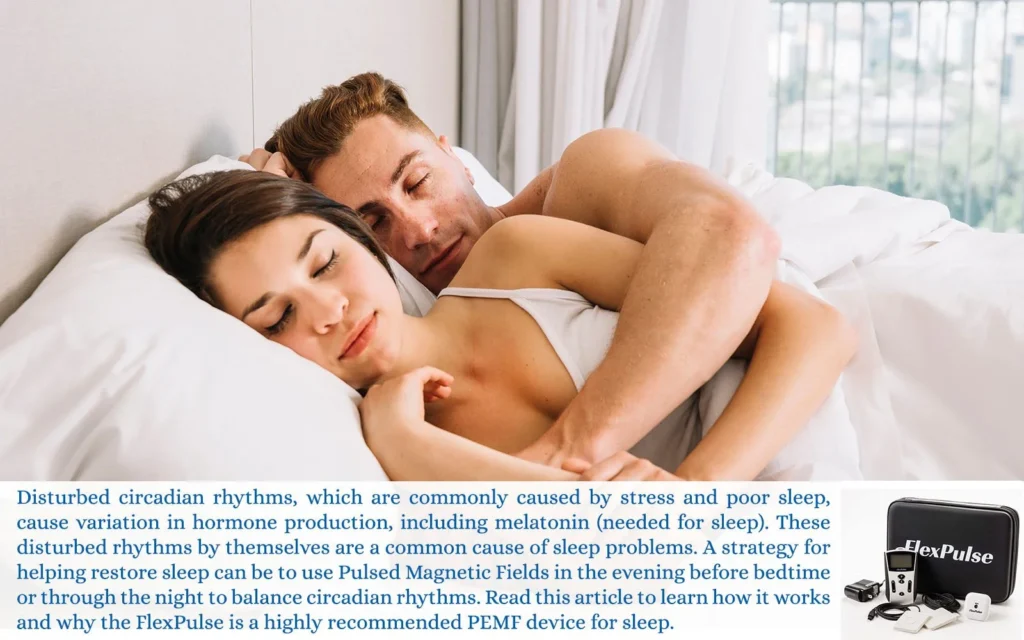
- Circadian rhythms, the natural cyclical rhythms of various body functions and hormone levels, are critical to healthy human functioning. They are very much affected by healthy sleep cycles. These rhythms can be affected by various environmental influences.Research in Germany in the 1960s and 1970s in a deep bunker, deprived test volunteers of external stimuli such as temperature, humidity, light, sound, and even the natural magnetic field of the earth. They found that these individuals developed disturbed circadian rhythms. Researchers then found that a weak square-wave 10 Hz field affected these circadian rhythms in a similar way to the natural fields, preventing them from drifting out of sync. (Wever)Disturbed circadian rhythms, which are commonly caused by stress and poor sleep, cause variation in hormone production, including melatonin (needed for sleep). Therefore, these disturbed rhythms by themselves are a common cause of sleep problems.
- Magnetic fields from a small 0.5 mT (5 gauss) 4 Hz generator were tested in a double-blind study. Effects on sleep were studied before exposure and after 2 weeks and 6 weeks of exposure.
Researchers reported fewer sleep disturbances in 83% of the exposed group, compared with 57% of the placebo controls. (Fischer)
- 100 people were evaluated in a 4-week double-blind, placebo-controlled PEMF study. They were placed into three groups: trouble falling asleep (sleep latency), interrupted sleep or nightmares. Evaluations were for how long it took to fall asleep, sleep interruptions, sleepiness after getting up, daytime sleepiness, concentration problems, and daytime headaches. In the active group, all criteria improved significantly. The placebo group also improved, but less. This was a single 4-week study of people with sleep complaints, using a different device from FlexPulse. (Pelka)
- A 2001 study in rats looked at how ultralow intensity electromagnetic fields change the effects of sedative and antipsychotic drugs. If you take sleep or mood medications, talk with your doctor before using PEMF, and never change a dose on your own. (Shtemberg)
The Theory Behind PEMF And Sleep
One proposed way lower intensity, frequency-based PEMF could interact with the brain is entrainment. Neuro-entrainment refers to the synchronization (also known as resonance) of an external frequency with the frequencies of the brain. A radio and radio waves are good example of how this happens. The radio is a tuner and the radio waves are tuned into the settings of the radio. When the radio wave frequencies match a particular spot on the dial of a radio, a clear signal is received or heard. The brain is effectively a frequency tuner. External PEMF frequencies are like the radio waves. The theory is that the brain will tune itself to a consistently applied external magnetic field frequency. The brain normally has many brain wave frequencies, ranging from 1 Hz to about 100 Hz. Hertz (Hz) is the cycles per second of a frequency.
Many parts of the brain are vibrating consistently at specific frequencies. The more areas of the brain vibrate at similar frequencies, the more the state of brain function is affected. The dominant frequency determines our mental state, and entrainment aims to shift it temporarily by boosting one frequency to be stronger than the others, such as the deep sleep frequency of 3 Hz.
These states are classified into five patterns, from lowest to highest: delta (1-4 Hz), theta (5-8 Hz), alpha (9-13 Hz), beta (14-24 Hz), and gamma (25-100 Hz). The brain functions mostly in delta and theta throughout the night. When a higher proportion of the brain waves vibrate or oscillate at delta or theta, the brain will dip into sleep.
Delta is the deepest and most restorative sleep and theta includes the lighter stages of sleep, including dream sleep (also called rapid eye movement – REM – sleep).
Delta occupies about 5-15% of total sleep time, in adults. Delta sleep typically occurs between 1 to 1½ hours after falling asleep. Children up to age 12 spend about 20-25% of their sleep time in delta. The rest of the sleep time for everybody is in theta.
For most people with sleep issues, the problem is either not being able to get into theta when falling asleep or spending too much time in higher theta or even in alpha levels. This means that there is too much awareness of not sleeping. So, the goal is to try to slow down more brain waves to spend more sleep time in lower theta (4-5 Hz) or even in delta.
The idea of brainwave entrainment is to help to gently induce the brain into the lowest frequencies. Audiovisual devices are often used to induce various brainwave states. They are impractical for use through the night. They operate indirectly to stimulate the brain by stimulating the auditory and visual centers of the brain. Magnetic field (PEMF) entrainment is more practical. Magnetic fields pass through the skull directly, and the idea is that they encourage brain cells and areas of brain cells to oscillate or resonate at the frequency presented to the brain.
A D.E.E.P. signal stands for Delta Enhanced Entrainment Program. For evening use, I prefer a Delta frequency, and specifically 3 Hz. My experience has been that 1 Hz PEMF drives the brain waves too low and the slow pattern may be more likely to be interrupted with because of the gaps between pulses. A single frequency is preferred to provide the brain a more consistent repetitive pattern.
Entrainment programs that ramp up or down may not provide enough stimulus time at any given frequency to adequately entrain larger areas of brain structures. At least, that has been my experience with audiovisual ramping programs. I have preferred a consistent pattern of a single frequency.
Further, ramping, for example, having frequencies going from 7 Hz, 6 Hz, 5 Hz, 4 Hz, 3 Hz, 2 Hz and 1 Hz, in sequence may not spend enough time at any given frequency to properly entrain the brain. As it is, presenting the brain with only one frequency, such as 3 Hz, will take time for enough brain cells to oscillate at the desired frequency. Then, once at that frequency, it should take less energy for the brain cells to stay there than to have to adjust to a change in frequency.
In other words, a change in frequency may run counter to what the brain would prefer to do. This way, with a single frequency, brain cells can do whatever they want but would generally be encouraged to pay attention to that one frequency. Also, when frequencies change, PEMF intensities change, further potentially reducing effects. As frequencies change upward—that is, get faster—magnetic field intensities decrease. As frequencies change downward, intensities increase. This is an engineering aspect of the way magnetic fields are electronically produced. This variability in intensities creates further unpredictability in the effects seen.
Ramping the brain up from lower to higher frequencies, to alertness, may have the same issues, causing the brain to ramp up faster than it would prefer. I have found that after stopping entrainment the brain very rapidly recovers its natural frequencies into alertness anyway.
Research has shown that chronic insomnia is associated with brain hyperexcitability. The theory is that neuro-entrainment could reduce this hyperexcitability by slowing down brainwave frequency patterns. Some studies have also looked at PEMFs and brain neurochemistry, including serotonin, GABA and endorphin levels.
Research still has not resolved the question of which came first, the frequency effects causing neurochemistry (nerve chemistry) changes or the nerve chemistry changes causing brain frequency pattern to change. It’s quite likely that both are interacting simultaneously. That means that multiple mechanisms of PEMF neurostimulation are likely at work.
General Considerations
It is because of the Graham research that I usually recommend using only continuous single-frequency PEMF stimulation all night. It’s preferable to use continuous stimulation during the night with brainwave resonant frequencies (Theta and/or Delta brainwave patterns). Also, experience has shown that when stimulation is stopped, the brain can rapidly revert to whatever pattern the brain desires. So, continuous stimulation provides more assurance that the brain will continue in the desired frequency pattern. PEMF Devices that have multiple frequency patterns run the risk of sleep disruption. The brain may want to move in a certain direction and the frequency pattern may be different, causing what I call resonance dissonance, or interference patterns.
So, I recommend PEMF systems that can be run throughout the night. They should not be at any frequencies higher than 7 Hz (upper end of Theta), preferably below 4 Hz, in the Delta range, and preferably 3 Hz.
The applicators can be placed near the bed, under the pillow, between the mattress and the box spring, or under the head directly. The best placement is directly under the head, as close to the head as possible. An even better placement would be at the top of the neck, at the level of the brainstem. Because it is awkward to place and retain a coil at the top of the neck, anywhere around the brain should work.
The part of the brain that controls consciousness or levels of wakefulness and sleep is called the reticular activating system (RAS). It is located at the base of the brain (the brain stem), basically behind the upper part of the neck. The idea is that stimulating the RAS with low-frequency Theta or Delta PEMFs may influence levels of awareness and wakefulness, so the RAS is my main target. Other parts of the brain can be stimulated too, but I prefer targeting the RAS directly.
The coil applications would most likely be to the sides of the head just above the ears (the parietal lobes of the brain). While much of the research looks at the left side of the brain, it is not definitively shown that stimulation of other parts of the brain would not be as effective. Ultimately, individuals will have to try and see what the best approach is for them.
Whole-body PEMFs and Sleep
Whole-body PEMF systems can be used, but they have limits for this use. This is because most whole-body PEMF systems are very low intensity and do not run all night. Even if they do run all night, because of the low intensity, the strength of the magnetic signal reaching the brain and nervous system is very limited through a law of physics. For this reason, a higher intensity device delivers more of its field to the brain.
The law I refer to is the inverse square law. It means that the magnetic field drops off very rapidly as you move away from the source of the magnetic field—in this case, the applicators. This law applies to any forms of radiation, including sound, heat, light, and magnetic fields. The field strength does not decrease because the magnetic field is being used up by the body or interacting with the body. Magnetic fields are not blocked or reduced by the body whatsoever as they pass through. The magnetic field changes the body, but the body does not change the magnetic field.
Some PEMF systems recommend placing the coil between the box spring and the mattress. Because of the inverse square law, very little magnetic field reaches the head. As a result, I rarely recommend this placement.
High-intensity, pulse-based PEMF magnetic stimulation to the brain (transcranial magnetic stimulation) is often provided in a professional setting. Lower cost, relatively high-intensity pulsed PEMF devices are available for home use. In the professional setting, sessions are given during the day. At home, PEMF can be used closer to bedtime.
Placement of the Magnetic Coil
For all the above reasons, I recommend that a frequency-based PEMF system be used as near to the head as much possible—preferably to the neck. Putting a coil or coils on the side of the head at the level of the ears will still help to stimulate the RAS, but the PEMF signal may be easy to hear and be a distraction during sleep. Placing the coils at the back of the neck is less likely to create this possibility. For people who have trouble sleeping on their backs, placing a coil below the ear toward the back of the neck is another option.
Some people prefer placing the coil on the belly. The gut is considered the “second brain.” The gut has as many or more neurons than the brain has, and the gut produces most of the serotonin for the body. Also, the solar plexus, in the upper belly, is the largest autonomic nerve center in the abdominal cavity. The sympathetic nerves to the abdominal organs, glands, and blood vessels relay here, or pass through to other satellite plexuses. The adrenal glands are stimulated by this plexus, releasing adrenalin and cortisol into the blood. In addition, branches from the parasympathetic vagus nerve also pass this way to the abdominal organs. These nerve fibers activate the muscles and glands of the gut and carry feedback to the brain about gut sensations and reduce blood pressure. Some people find a coil on the belly relaxing. Some may place the coil near the head for part of the night and on the belly for another part or rest of the night.
All of the above applies to the typical person, but the placement and intensities of the PEMF system for sleep may need to be different for people who are extremely sensitive to PEMFs (this is known as electro-sensitivity). In this situation, the PEMF signal should be placed at the head level but as far away from the head as is comfortable. What to do will have to be a matter of trial and error.
Using The FlexPulse In The Evening
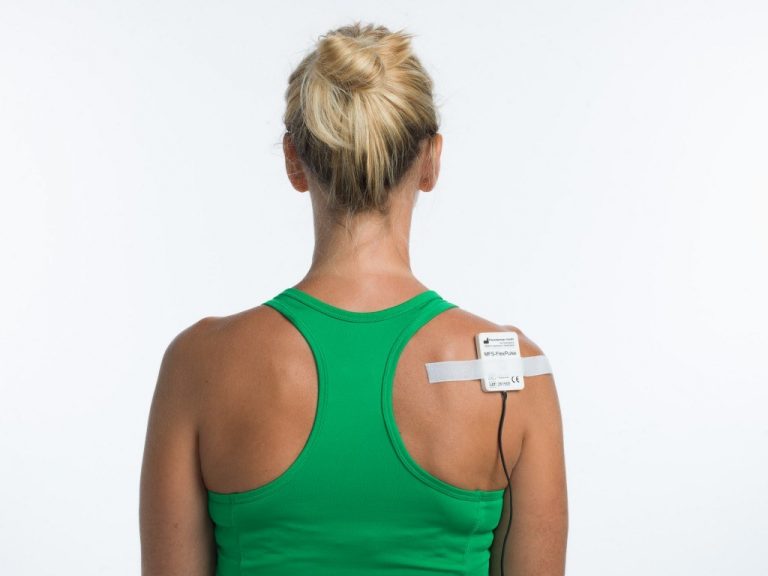
The system I recommend the most is the FlexPulse. The FlexPulse is a rechargeable, battery-operated system with a single small flat coil producing about 200 Gauss. It has 6 programs with individual frequencies. It can operate continuously throughout the night until the battery is fully discharged. I usually recommend maximum intensity (10) on program 3, which is 3 Hz, the Delta frequency.
A single coil can be placed under the pillow, anywhere around the head, or preferably at the back of the neck. Positioning at the back of the neck requires sleeping on one’s back. For people who sleep on their sides, the coil can be placed on the side of the neck slightly back of and below the ear. Placing a coil too close to the ear may be distracting because the coil has a clicking sound at maximum intensity. On the other hand, I find that some people use the clicking sound as a form of auditory entrainment, which can be reassuring that the coil is obviously working. I consider the clicking to be my nighttime friend.
The other consideration for placement under the pillow is that, in theory, once the brain is entrained into Delta, movement away from the coil will still maintain entrainment. The most entrainment will happen directly over the coil, but even as you move away there will still be some maintenance of the entrainment. This is similar to what happens when you move an analog radio dial off the sweet spot for a particular station. There will still be enough signal to maintain capture of the station.
References
1. Fischer G and Kokoschinegg PJ. The treatment of sleep disturbances and meteorosensitivity by pulsed magnetic fields of low intensity. Bioelectr 9(2):243 Third Symposium on Magnetotherapy and Magnetic Stimulation, 12-14 October 1989, Hungary, 1990. DOI: 10.3109/15368379009119812
2. Graham C and Cook MR. Human sleep in 60 Hz magnetic fields. Bioelectromagnetics 20(5):277283, 1999. DOI:10.1002/(SICI)1521-186X(1999)20:5<277::AID-BEM3>3.0.CO;2-U
3. Pelka RB, Jaenicke C, Gruenwald J. Impulse magnetic-field therapy for insomnia: a double-blind, placebo-controlled study. Adv Ther Jul-Aug; 18(4):174-180, 2001. [Pubmed]
4. Shtemberg AS, Bazian AS, Shikhov SN, et al. Modulation by ultralow intensity electromagnetic fields on pharmacologic effects of psychotropic drugs. Zh Vyssh Nerv Deiat Im I P Pavlova 51(3):373-377, 2001. [Pubmed]
5. Wever R. Effects of low-level, low-frequency fields on human circadian rhythms; Neurosci-ResProgramBull. 1977 Jan; 15(1): p. 39-45. [Google Scholar]